
Auditable Cognitive Infrastructure for Neurodegenerative Disease Research
Auditable cognitive infrastructure for neurodegenerative disorders integrating genetics, proteomics, and neuroimaging within the tridimensional framework described in a peer-reviewed publication. Supports comprehensive evidence structuring across 22 neurodegenerative diseases.
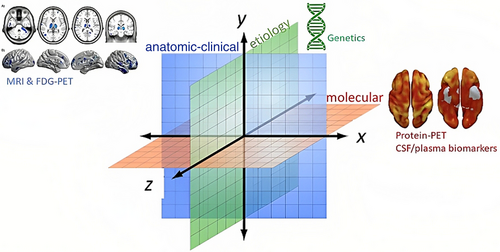
Tridimensional Analysis Framework
The tridimensional framework, described in a peer-reviewed publication, analyzes neurodegenerative diseases across three fundamental biological axes. Each axis represents a distinct level of pathophysiological organization. Inference is anchored in an auditable, deterministic, and Bayesian core by design, ensuring transparent, biologically grounded reasoning across all disease axes.
Axis 1: Etiological Factors
Comprehensive genetic risk assessment including pathogenic variants, polygenic risk scores, and environmental modifiers.
Examples: APOE ε4 dosage, LRRK2 G2019S, C9orf72 expansions, MAPT mutations, HTT CAG repeats
Axis 2: Molecular Biomarkers
Multi-omics integration of CSF, plasma, and tissue biomarkers across pathogenic cascades.
Examples: Aβ42/40 ratio, p-tau181/217, α-synuclein RT-QuIC, TDP-43, neurofilament light
Axis 3: Topographical Phenotype
Quantitative neuroimaging analysis and standardized anatomical atrophy mapping.
Examples: Hippocampal volumetry, cortical thickness, white matter integrity, amyloid PET SUVR
Clinical Research Applications
Designed for clinical research environments and pharmaceutical discovery. Supports biomarker validation, drug target verification, and clinical trial stratification.
Biomarker Discovery
- • Multi-omics pathway analysis
- • Cross-disease biomarker validation
- • Longitudinal progression markers
- • Treatment response indicators
Clinical Trial Support
- • Patient stratification algorithms
- • Endpoint sensitivity optimization
- • Statistical power estimation
Drug Development
- • Target engagement verification
- • Disease-modifying therapy tracking
- • Companion biomarker protocols
Structured Analysis Pipeline
Multi-modal data formatting
Significance and FDR correction
Cross-validation and bootstrap
Audit-ready documentation
Methodological Rigor & Epistemic Safeguards
Every analytical claim in Neurodiagnoses is constrained by leakage-free validation, full run accounting, and empirical null controls.
Zero-Leakage & Sealed Holdouts
Patient-level grouping (NACCID), nested cross-validation with in-fold imputation, and SHA-256 sealed holdout cohorts (Lockbox) to prevent silent data reuse.
Full Run Accounting (CONSORT-style)
Append-only, hash-chained execution ledger (RunLedger) that logs every registered, completed, failed, or abandoned analysis—eliminating selective reporting.
Replication & Empirical Null Controls
Multi-seed replication across 4-axis contributions (Axis 0–3) and patient-level label permutation testing. Unstable findings remain labeled as hypotheses.
Data-Grounded vs. Prior Knowledge
Explicit ablation against literature-only baselines to separate genuine data-driven signal from prior clinical knowledge.
Advance Neurodegenerative Disease Research with Structured Methods
Built for research institutions and clinical investigators conducting biomarker discovery and clinical trial design.